
Guest Referral
Role: Research & Content Strategist & Creative
Brief
Airbnb’s growth depends on acquiring new guests efficiently while keeping the brand experience warm, human, and trust-building. A guest referral program can turn satisfied travelers into advocates by rewarding them for inviting friends to try Airbnb for their first trip.
As the content strategist, I partnered with Design, Product, and regional teams to simplify the referral flow, align the experience with Airbnb’s brand voice, and make incentive terms clear and transparent—without overwhelming users.
Challenges
Monetization meets warmth: Highlighted the incentive without compromising Airbnb’s warm, community-driven voice.
Promo but not pushy: Balanced promotional clarity with legal requirements, translating disclaimers into terms users could actually understand.
Tone consistency and global-ready content: Stayed consistent across markets, aligning with Product, Design, Legal, and Localization teams globally.
User Insights
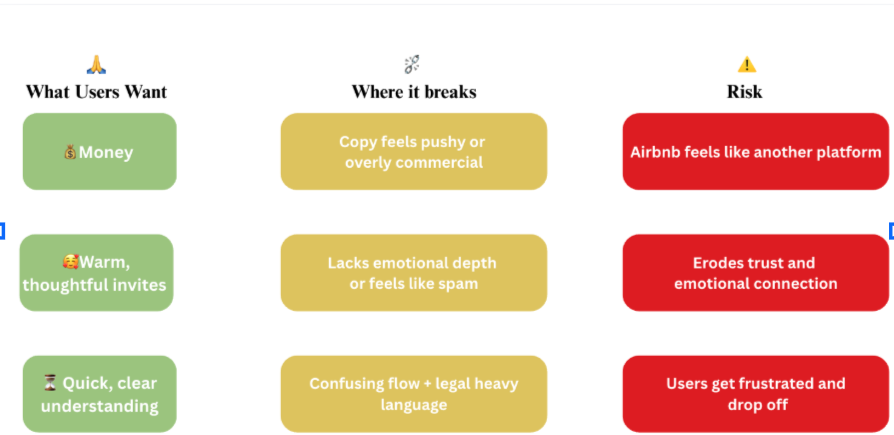
How would users think about those referral programs in their daily life? From early user research and stakeholder interviews, I uncovered several key insights:
Content Strategy
- Balance brand warmth with incentives
After multiple rounds of discussion with the business team, we aligned on the most incentive-focused version, a clear and direct message that prioritized conversion while still respecting Airbnb’s brand voice.
Early Concepts:
V1: “Share your love of travel”
→ Emotionally aligned with Airbnb’s tone, but too vague. It didn’t clearly communicate the incentive.
V2: “Refer friends to Airbnb. You’ll get $10.”
→ Clearer, but it lacked user benefit upfront and still felt wordy on mobile screens.
Final Version:
“Give up to $50, get $10”
Balanced both sides: user-first clarity, incentive-focused language, and a clean, digestible format ideal for mobile UI. And it still retained Airbnb’s brand generosity and trust by leading with users’ benefit.
But it started to feel a little too transactional…and how to balance that with Airbnb’s warm, human brand’s voice?
Humanizing the Experience: From Transaction to Invitation
While the referral program was incentive-driven, we wanted the experience to feel personal and generous and not like a cold marketing transaction. To warm up the flow and align with Airbnb’s brand spirit, we reframed the entire referral action as a thoughtful invitation between friends.
⏵ From telling a story:
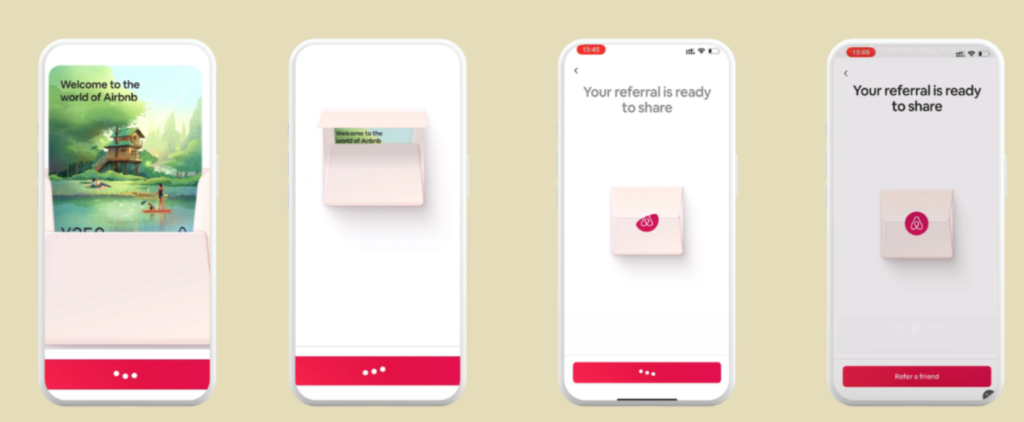
Visual metaphor: Designed the referral page to resemble a beautifully illustrated invitation card, evoking warmth, nature, and human connection.
Tagline added: “Welcome to the world of Airbnb” — a poetic entry point that replaces promotional language with emotional resonance.
Micro-animation: As users sent the referral, the card was sealed in an envelope with the Airbnb logo and animated to “send”, adding a small moment of delight that reinforces the gesture’s personal nature.
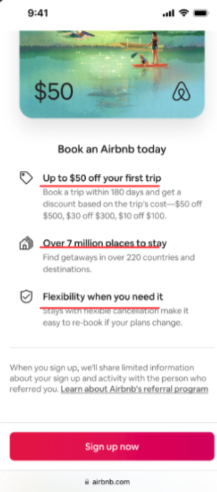
⏵ Turning legal terms into benefits that convert:
- Put users’ benefit first
Starts with the what’s in it for receivers: “Up to $50 off”, Over 7 million places”, “Flexibility when you need it”.
- Scannable content hierarchy
- Bold headers + light explanations help users scan quickly, especially on mobile.
- Each point is structured as: Headline = hook (benefit) + Subline = supportive detail (specific terms or context).
- The tone remains helpful, not overwhelming even when including rules like “within 180 days” or “based on trip cost”.
- Clarity and reassurance in decision moments
- The third point (“Flexibility when you need it”) speaks directly to a core user concern: cancellation anxiety.
- Instead of saying “flexible cancellation policy applies,” it speaks like a friend: “make it easy to re-book if your plans change.”
Impact
Achieved a 23% share rate and 41% of first-time bookings (FTB) sign-ups.
Improved completion by clarifying incentive rules and adding emotion-led framing, increasing trust and engagement across key steps.
Localized adaptations made the offer resonate across culturally diverse markets, increasing regional relevance and participation.
Strengthened the connection between content design and business growth, demonstrating how UX writing directly contributes to measurable performance.