
Host Referral
Role: Research & Content Strategist & Creative
Brief
Airbnb launched the Host Referral Program to increase host supply by motivating users to invite friends to become new hosts. Rewards were granted to both the referrer and the referred host after the new host completed their first booking.
I led the content strategy and UX writing for the referral flow, aligning with Product, Design, Legal, and Localization for a global launch.
Challenges
Brand vs. Incentive Clarity: Keep Airbnb’s warm tone while stating rewards/eligibility with zero ambiguity.
Trust Sensitivity: Make “when you get rewarded” and “who qualifies” explicit to reduce skepticism and misuse.
Compliance x Clarity: Balanced promotional messaging with plain-language terms users could understand.
Global rollout: Ensure message stays consistent across languages despite length expansion and local compliance needs.
User Insights
How do users think about referral programs in daily life? From early user research, I uncovered several key insights:
Legal overwhelm: Dense disclaimers felt intimidating, making the program seem complex or risky.
Host-type confusion: Unclear differences between host types created hesitation to refer.
Perceived effort: Too many steps and unclear next actions increased friction or commitment felt too early
Content Strategy
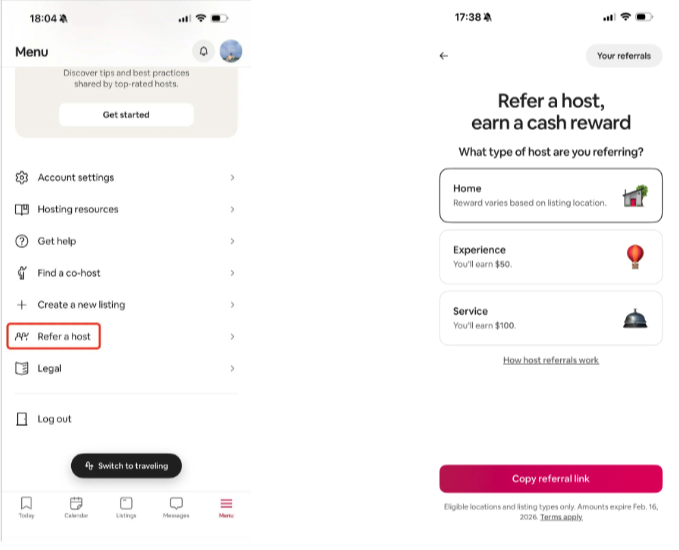
To reduce confusion and help users distinguish between different host types, I used a combination of content clarity and visual hierarchy:
-
Used visual icons for instant recognition
Each host type was paired with a unique, self-explanatory icon, helping users differentiate different types at a glance. -
Introduced host categories upfront the journey
An info pop-up appeared right after clicking “Refer a host,” giving users an upfront heads-up about the three distinct host types.
Always Set Expectations:
Clarify the Flow Up Front
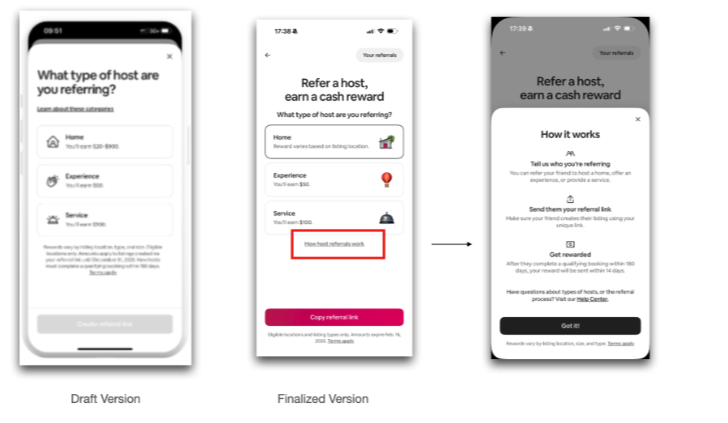
In the first draft, I didn’t include “How referral works” section on the landing page because the three referral programs had slightly different mechanics.
My assumption was that users would see the relevant details after selecting a specific program, and that surfacing the full flow upfront would take up valuable space on mobile.
After the first bug bash, feedback showed that some users needed a quick, high-level view of the process to understand what they’d be asked to do before committing.
Partnering with the designer, we introduced a collapsible “How it works” section so users could access the overview on demand without adding clutter to the surface.
Linked out supporting pages
For lesser-known host types (e.g., experience and service Hosts), we included contextual links to official pages so users could learn more without getting lost.
Maintain Consistency Across Variants
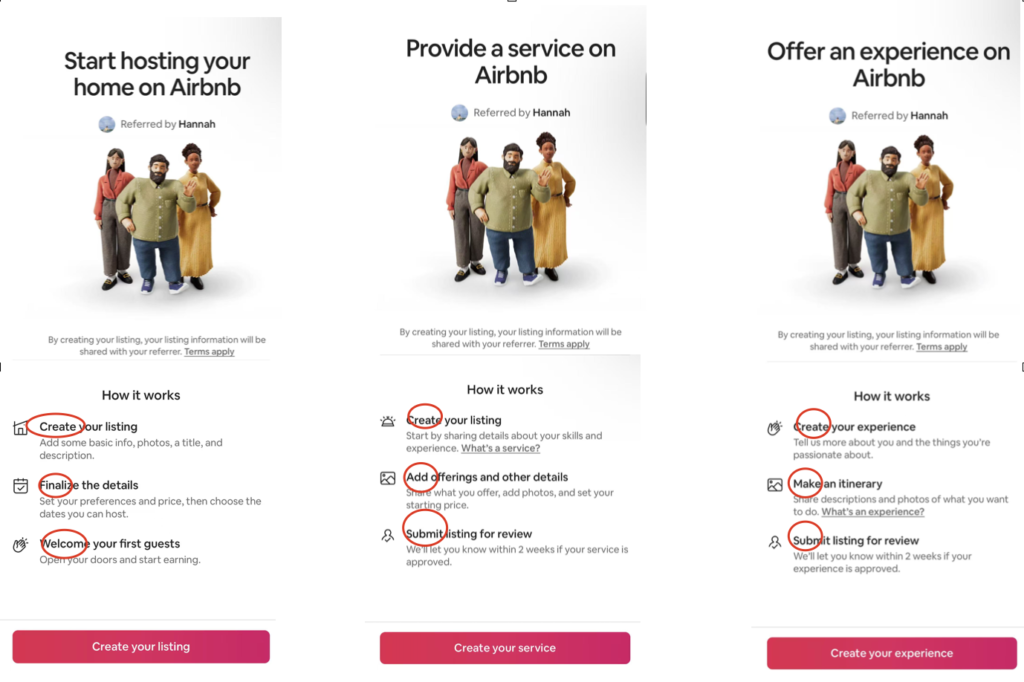
Although the Host Referral Program included three distinct host types, we ensured a unified experience through both visual and verbal consistency:
Aligned page structure
Each referral page followed the same layout with only minor variations like iconography and key terms, allowing users to quickly recognize the structure and focus on the content.Standardized sentence patterns
To reinforce clarity and ease of comprehension, we used consistent phrasing across all categories:
Headlines began with strong action verbs (e.g., “Invite a friend,” “Earn rewards”).Sub lines were concise, limited to three lines, and followed a uniform tone and rhythm.
This approach not only improved usability and comprehension but also helped scale the experience globally with easier translation and localization.
Make content more human-centered, personal and conversational
Clear and friendly tone
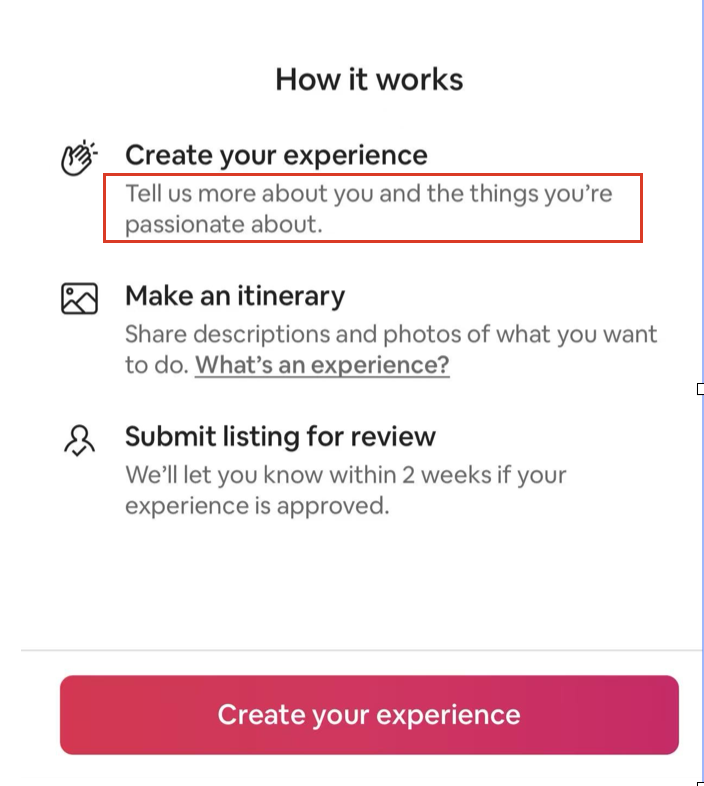
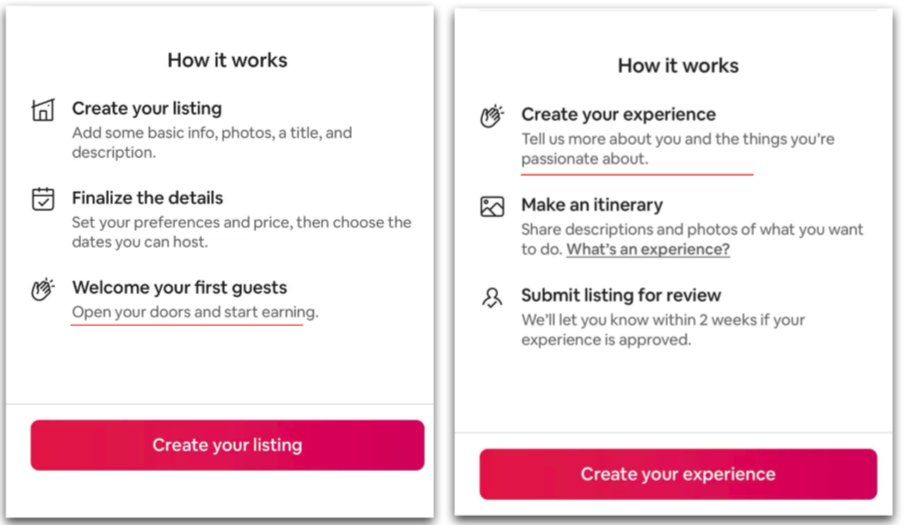
- Each screen uses plain, direct language that feels approachable. For example: “Tell us more about you and the things you’re passionate about.” “Open your doors and start earning.” These phrases feel like a real human is talking to you, not a robot. And they avoid jargon and use empathy-driven, encouraging verbs.
- Conversational action verbs: each flow begins with “Create,” which is more inviting than technical terms like “Set up.” The follow-ups : “Finalize,” “Make an itinerary,” “Add offerings” sound purposeful but casual, which nudges users to keep going without feeling overwhelmed
Cross-functional Collaboration
Led cross-functional feedback loops across product, design, marketing, and executive teams.
Consolidated and distilled feedback into actionable insights to refine content direction.
Collaborated closely with the localization team to ensure the messaging stayed consistent, culturally relevant, and resonant across 120+ markets and languages.
Impact
25% increase in sharing rate, indicating improved user clarity and confidence in the referral process.
8% growth in new host registrations, directly contributing to supply-side expansion.
Successfully supported the global launch of M13, Airbnb’s new Experience & Service business, with aligned messaging and seamless onboarding.
Strengthened brand consistency across markets, helping the Host Referral initiative resonate in diverse cultural contexts without losing its warmth or clarity.